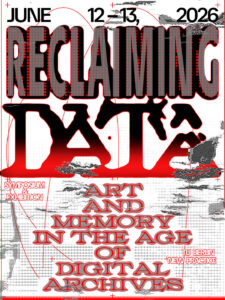
How do digital archives shape the ways we remember? Who decides what remains visible, what gets rewritten, and what disappears? And what happens when generative systems begin to reorganise the past through datasets, statistical models, and platform infrastructures?
Reclaiming Data is a symposium and exhibition that brings together artists, researchers, students, and cultural institutions to explore how artificial intelligence, digital archives, and data infrastructures are transforming collective memory. Across two days, the program moves between keynote, screening, workshops, panel discussions, performance, and exhibition, creating a space in which artistic, theoretical, and institutional perspectives can meet.
The symposium asks: How do digital archives shape the ways we remember? Who decides what remains visible, what gets rewritten, and what disappears? And what happens when generative systems begin to reorganise the past through datasets, statistical models, and platform infrastructures?
At its core, Reclaiming Data begins from the observation that today’s archives are no longer only institutions of preservation but increasingly operational systems: they sort, model, predict, and generate. In this sense, generative systems can be understood as inherently “nostalgic” technology. Trained on past data, they reconstruct patterns and produce synthetic versions of history. The project asks how these infrastructures shape historical consciousness, and how artistic and critical practices might intervene in them.
The symposium unfolds across three thematic trajectories. The first addresses the biases, exclusions, and political asymmetries embedded in datasets and platform systems. The second focuses on artistic and activist practices of reappropriation – from reverse archaeology to synthetic historicity. The third opens toward questions of commons, institutional responsibility, and community-oriented forms of archiving, asking how critical perspectives can be translated into concrete practice.
The symposium opens on Friday, 12 June, with a keynote by Roland Meyer, whose work on networked image cultures and generative image worlds sets the discursive frame for the event. This is followed by a screening of Afterlives by Kevin B. Lee, and an aftertalk with Orit Halpern, opening questions of historicity, mediation, and synthetic image culture.
On Saturday, 13 June, the day begins with three parallel workshops by Michael von zur Mühlen, Allapopp, and !Mediengruppe Bitnik, each approaching datasets, memory-making, and digital infrastructures through different practical methods.
In the afternoon, two panels bring together artistic and institutional perspectives. Panel 1 focuses on artistic forms of reappropriating digital infrastructures of the past, featuring Nora Al-Badri, Juan Covelli, and Egor Kraft. Panel 2 turns toward commons, community archives, and institutional practice, with invited participants from HKW, Staatsbibliothek zu Berlin, and Trust Support. The symposium closes with the roundtable “Where do we go from here?”, a reflection format that aims to translate the discussions into possible next steps, alliances, and practical perspectives.
Most symposium formats are open to the public. Attendance is free.
Workshops require prior registration due to limited capacity.