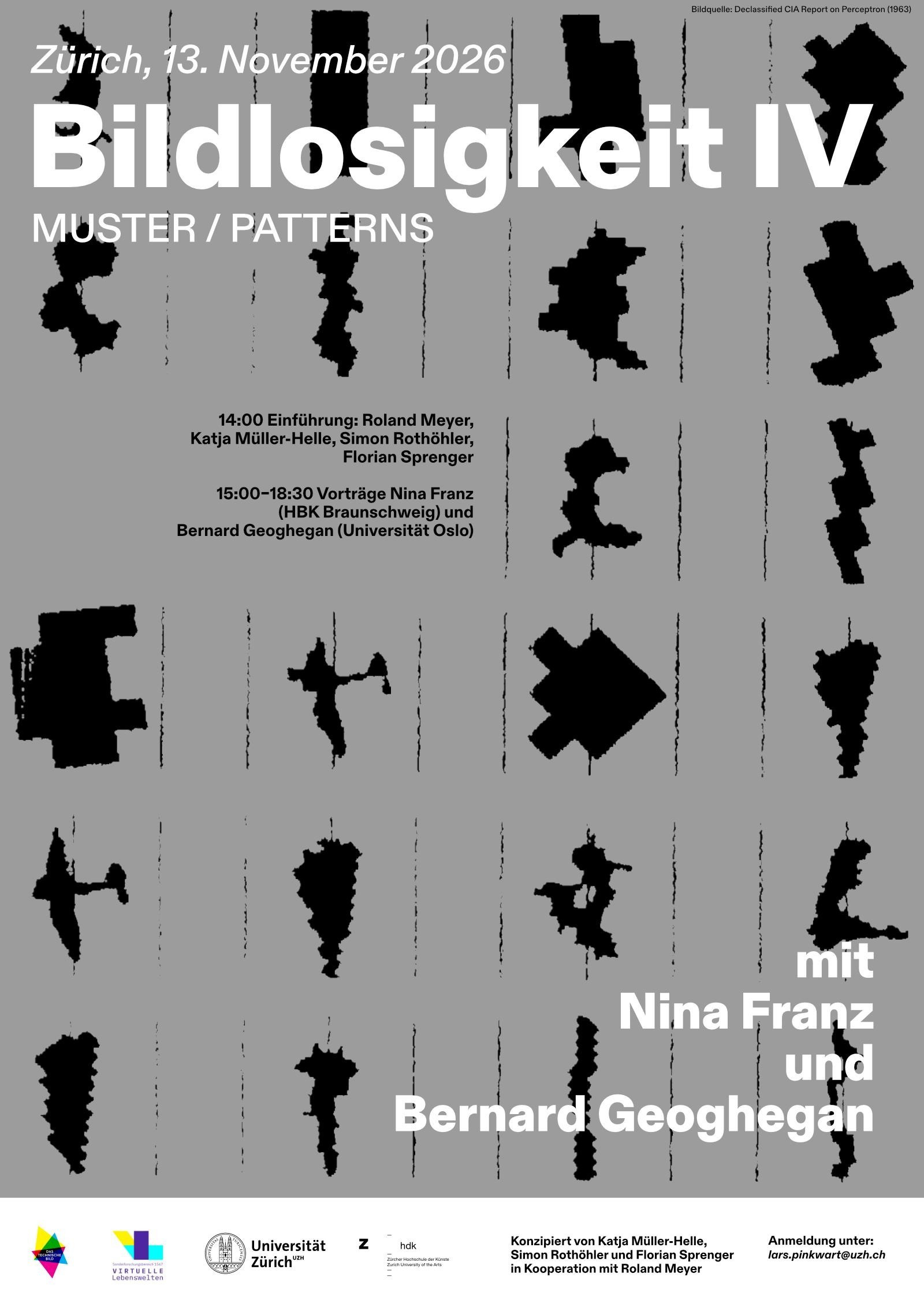
With the current AI hype, the concept of the pattern has once again gained prominence. For what is currently marketed as “artificial intelligence” is fundamentally based on pattern recognition: artificial neural networks are trained to recognize, classify, analyze and vary recurring patterns in vast quantities of images, texts, sounds and other data. The analysis of patterns enables predictions, from climate research to automated targeting; their variation allows for the endless production of supposedly new content, all the way to notorious AI slop. Yet the concept of the pattern, as defined by cybernetics and information theory already around 1950, stands in a peculiar tension with the visual. For Norbert Wiener, a pattern could denote anything that could be detached as information from an individual instance, repeated in variations and calculated statistically. Since Frank Rosenblatt’s Perceptron in the late 1950s, however, automated pattern recognition has focused primarily on visual patterns in collections of images – not least in the interest of military aerial reconnaissance. To what extent, then, could data patterns be understood as “imageless”? And how profoundly have concepts of the image and of image operations shaped the history and present of digital pattern recognition?
In a dialogical format, Nina Franz (Braunschweig University of Art) and Bernard Geoghegan (University of Oslo) will shed light on the visual and media history of patterns and pattern recognition and address questions concerning the visuality and invisuality (the “imagelessness”) of data patterns.
The Zurich event is the fourth in the workshop series “Bildlosigkeit” (“imagelessness”), which, since 2024, has explored the precarious processes of translation between data and images: What do data visualizations visualize? By whom are images seen that do not address the human eye? What are the implications of “invisual images” (Munster/Mackenzie) for image and media theory? Following the first workshop on “sensor images” with Kathrin Friedrich and Antonio Somaini in Bochum, the second workshop in Berlin with Tom Holert and Ute Holl addressed historiographical questions surrounding the “operational image” (Farocki), while the third workshop, held in Paris in 2025 with Claus Pias and Estelle Blaschke, subjected the thesis “The Digital Image Does Not Exist” to a critical revision.
Conceived by Katja Müller-Helle (Das Technische Bild, Humboldt-Universität zu Berlin), Simon Rothöhler (CRC Virtual Lifeworlds, Ruhr University Bochum) and Florian Sprenger (CRC Virtual Lifeworlds, Ruhr University Bochum), in cooperation with Roland Meyer (Bridge Professorship for Digital Cultures and Arts, University of Zurich and Zurich University of the Arts – ZHdK).
Preliminary schedule
13:30 Arrival and coffee
14:00–14:45 Introduction: Roland Meyer, Katja Müller-Helle, Simon Rothöhler, Florian Sprenger
14:00-14:45 Short coffee break
15:00–16:30 Input & discussion: Bernard Geoghegan, Classification or Cacography? Pattern Recognition in Humans and Machines
16:30–17:00 Coffee break
17:00–18:30 Input & discussion: Nina Franz, Seeing like a State. Population-based Pattern Analysis at War
18:30 Apéro
Please register via lars.pinkwart@uzh.ch